

Nova Scotia BANS is posting this press release onbehalf of:
Halifax Department of Perpetual Pilot Projects & Unintended Consequences (DPPPUC)
City of Halifax — Excellence in Mobility Reduction Since 2016
For Immediate Release: November 26, 2025……Or Whenever Traffic Allows

Halifax Unveils Bold Plan to Become Canada’s First Post-Functioning City
Halifax, NS — In a major announcement today, the Department of Perpetual Pilot Projects & Unintended Consequences (DPPPUC) confirmed that the municipality is moving confidently toward its long-term strategic vision: a city where movement is virtually impossible and businesses survive purely on optimism.
“Our planners have done groundbreaking work,” said Acting Director Blythe Gridlock. “They’ve proven that with enough speed humps, lane reductions, and contradictory road closures, we can bring Halifax to a full and meaningful halt.”
Why We’re Doing It
According to internal notes accidentally stapled to the press package:
- Did not test any design during winter.
- Assumed all residents are between 23 and 32 and own a Dutch cargo bike.
- Traffic modeling software last updated during the Hamm government.
- Business impact assessment filed under ‘Maybe Later.’
Despite these findings, the city is confident the plan will succeed as long as the public does not analyze it, question it, or attempt to drive anywhere.
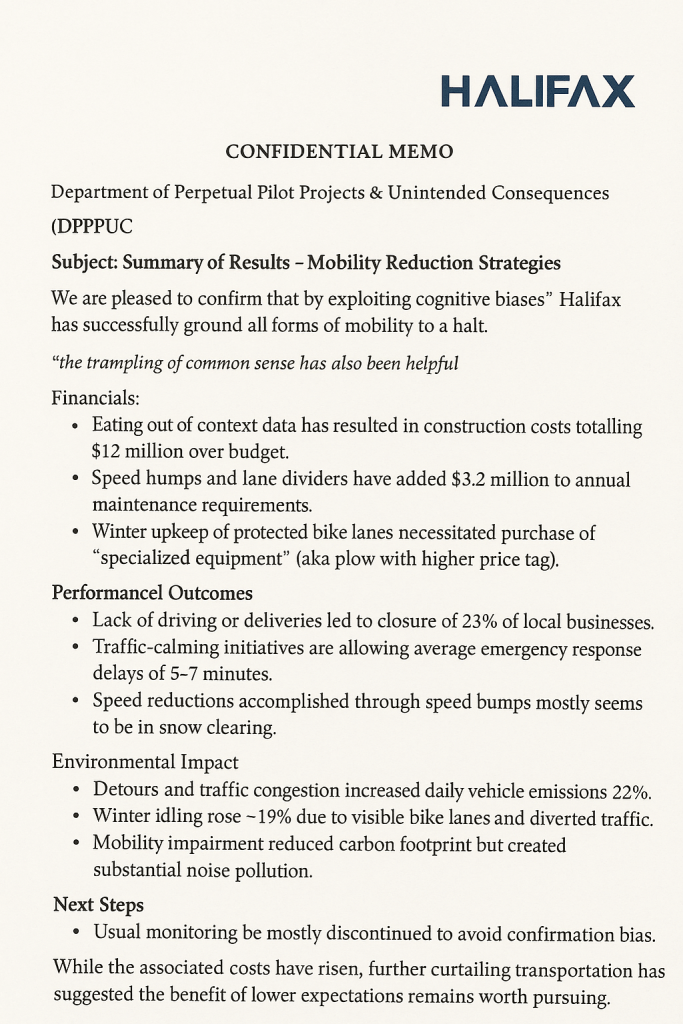
New Departments Supporting the Vision
Department of Never-Ending Construction (DNEC)
Mandate: Ensure at least three layers of construction occur simultaneously on every major Halifax artery, preferably with no posted timeline.
Department of Snowbank-Integrated Bikeways (DSIB)
Mandate: Celebrate successful cycling infrastructure from April to October; deny all knowledge of winter.
Division of Emergency Vehicle Detours (DEVD)
Mandate: Create a network of traffic-calmed cul-de-sacs so intricate that even Google Maps cries.
Key Cognitive Biases Driving Halifax Transportation Policy
Framing Effect
All policies will be branded with heartwarming slogans such as:
- “Safe Streets for All Ages (Except Drivers, Seniors, Delivery Workers, Tradespeople, Medical Patients, or Anyone with Groceries)”
- “Slower is Safer, Stopped is Safest.”
Availability Bias
One cyclist slips on a painted bike lane → full reconstruction of 18 streets.
One photo of a smiling person on a bike → $42M budget increase.
One resident complains about speeding → entire peninsula converted into a Level 1 Mario Kart course.
Confirmation Bias
Any data showing increased congestion, emissions, business decline, or emergency delays will be filed in the Drawer of Low-Value Evidence (located behind the locked door of the Division of Inconvenient Metrics).
Over-Generalisation
“If one quiet residential block can support a bike lane, obviously Robie, Bayers, and the MacKay Bridge can too.”
Status-Quo Bias (After We Change It)
Once a single speed hump is installed as a ‘pilot,’ the city immediately interprets this as universal approval for 20,000 more.
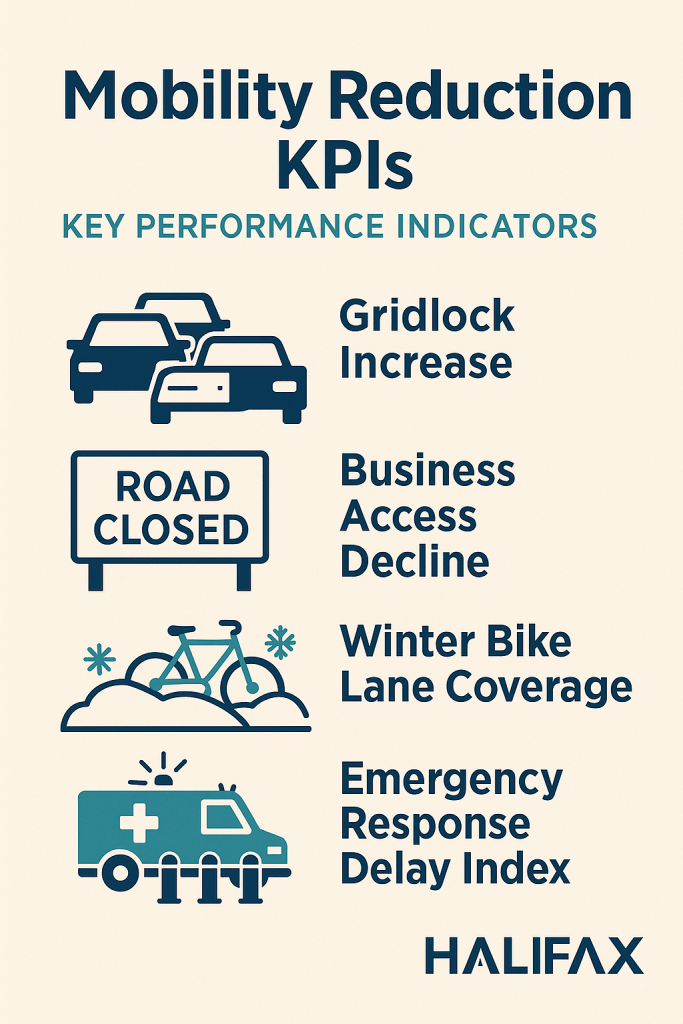
Key Performance Indicators (KPIs)
To ensure accountability and total lack of transparency, Halifax will measure success using new KPIs:
- Average February cyclist count: 0.4
- Number of lanes removed per 12-month cycle: ≥ 3
- Business access reduction index: Trending excellently downward
- Emergency response delay target: +4 minutes by 2027
- Snow-clearing conflicts with infrastructure: Daily, November–April
Environmental Impact (As Interpreted Selectively)
- Increased congestion emissions will be categorized as “Community Warmth,” supporting the unhoused.
- Snowplows burning extra diesel to maneuver through bollards will be filed under “Unexpected Environmental Vibrancy.”
- Businesses closing due to lost access are marked as “Carbon-Neutral Economic Events.”
Public Consultation Results
After extensive engagement (three Zoom meetings held at 2 p.m. on weekdays with 14 people total), the city confidently reports:
- 86% of participants supported “safer streets”, but no definition was provided so each infers something different
- 0% were informed of parking removal, delays in traffic and transportation, new traffic patterns, increases in frustrated drivers and road-rage incidents, added costs for fuel and goods
- 100% believed their feedback meant something, but we were doing it anyway and they helped us tick a box
2035 Vision: Halifax Without Movement
To ensure long-term urban, and then subruban paralysis, the city is pursuing:
The Halifax Crawlway™
A corridor designed so no traveler exceeds 4 km/h, ensuring absolute safety and spiritual reflection.
The Macdonald Bridge Mountain-Bike Experience
Traffic lanes removed to make room for Atlantic Canada’s first airborne cycling park.
The No-Road, Road Pilot
A street closed to cars, cyclists, pedestrians, dogs, delivery trucks, and emergency vehicles so the city can measure the safety benefits of nobody being able to use it.
Statement from the Director
“We are committed to making Halifax the safest city in the world,” said Director Rowan Stopp.
“A city that does not function is a city that does not crash.”
 Nova Scotia Bureau of Absurd Nova Scotia
Leave a comment