
Province of Nova Scotia
News Release
Date: August 19, 2025
Province Commits to Perpetual Rail Studies to Preserve Tradition
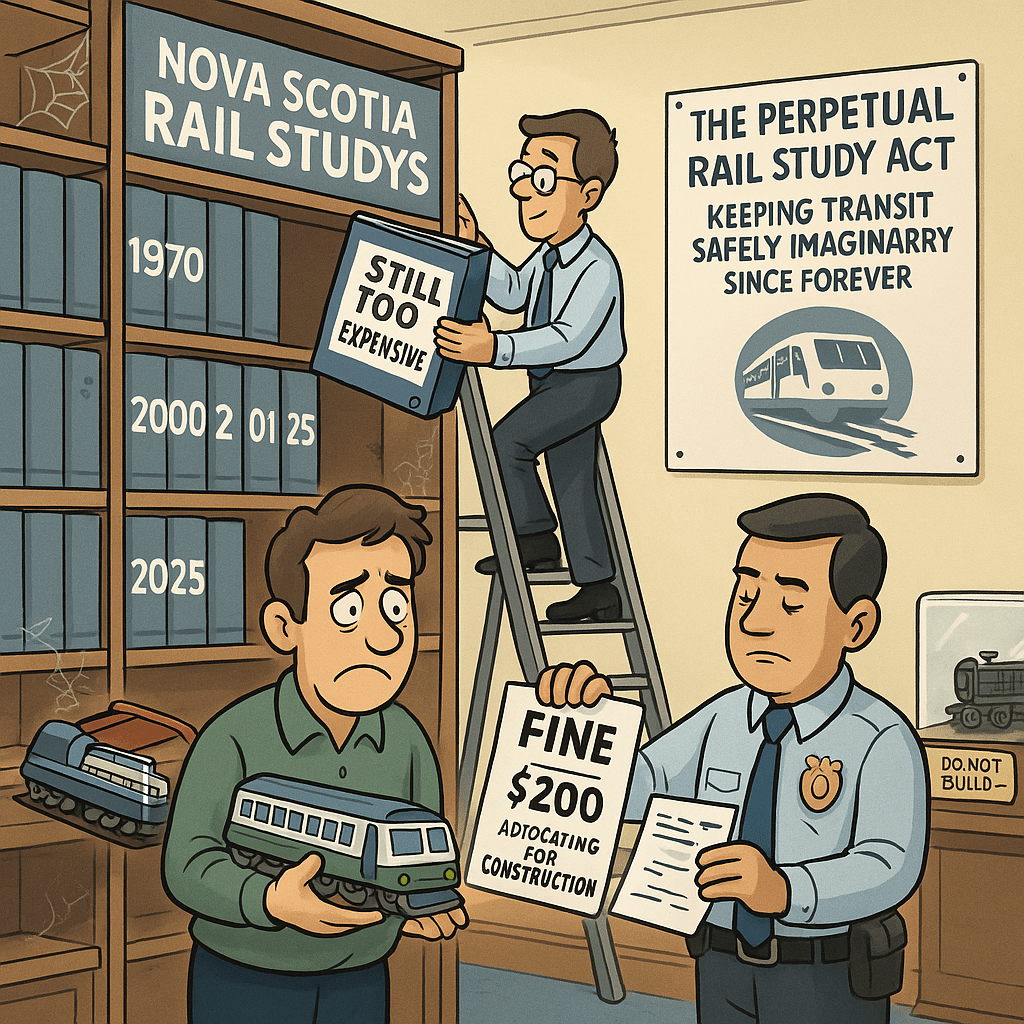
Halifax, Nova Scotia — The Province of Nova Scotia has announced a new policy formalizing its decades-long tradition of conducting passenger rail studies every 10–20 years, for eternity. Officials confirmed the studies will continue to deliver the same reliable conclusion: rail transit is “too costly for Nova Scotia.”
The practice, dating back to the 1960s, ensures that no matter how bad traffic gets in Halifax or how high fuel prices climb, the outcome will remain consistent: “We studied rail, and it just won’t work here.”
“Nova Scotians can take comfort in predictability,” said a spokesperson for the Department of Motion Illusion. “Every generation gets its own glossy feasibility study, and every study delivers the same answer.”
Historical Context
- Early rail studies in the 1960s and 70s found rail transit unaffordable — a tradition proudly upheld for more than half a century.
- The process became easier after CN Rail removed or sold off much of its infrastructure around Halifax and Nova Scotia, ensuring fewer physical tracks to actually work with.
- Former rail corridors have been steadily converted into bike trails, allowing the government to point to “active transportation” as a substitute for actual transit.
New Initiatives
To modernize this tradition, the Province has committed to also studying “bike trains” — long convoys of cyclists riding in formation to simulate rail service. Officials claim bike trains will offer a “low-emission, high-confusion” alternative to commuter rail.
Other alternatives under review include:
- “Bus trains,” in which several buses line up and drive together for morale.
- “Virtual trains,” provided through government-funded PowerPoint presentations.
Enforcement
The Perpetual Rail Study Act mandates that:
- A new rail study must be commissioned at least once every 20 years, or more often if traffic complaints spike.
- Findings must always conclude that rail is “impractical, unaffordable, or inconvenient.”
- Citizens caught advocating for actual construction will be fined the equivalent of “a monthly commuter pass.”
Reminder to the Public
Nova Scotians are reminded that rail transit will always be studied, never built. Officials reassured residents that while traffic congestion worsens and housing spreads further into rural areas, the tradition of studying instead of doing remains one of the province’s most stable institutions.
“By committing to perpetual rail studies, Nova Scotia is protecting the past, stalling the present, and avoiding the future,” said the spokesperson.
Quick Facts
- The first major Nova Scotia passenger rail studies date back to the 1960s, each concluding rail is “too expensive.”
- Since then, studies have been repeated roughly every 10–20 years, producing identical findings.
- CN’s removal of rail lines around Halifax made the studies both easier (fewer options) and harder (no tracks left).
- At least 12 former rail corridors have been converted into multi-use trails and bike lanes.
- The Province is currently studying “bike trains” to replicate the experience of rail without the inconvenience of tracks.
- Average study cost: millions. Average trains built: zero.
Media Contact
Ms. Illa Bus, Director of Illusory Transit
Department of Motion Illusion
Government of Nova Scotia
Email: stillwaitingfortrains@novascotia.ca
 Nova Scotia Bureau of Absurd Nova Scotia
Leave a comment