
News Release
Date: July 17, 2025
Cycling and Bike Lanes Banned to Meet Climate Targets
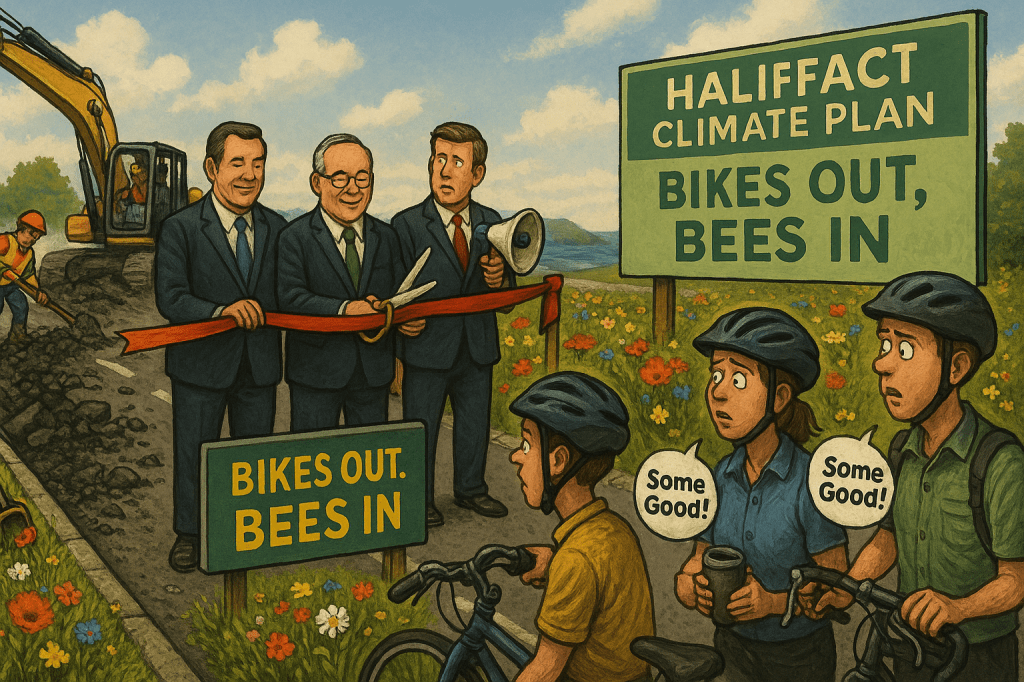
Halifax, Nova Scotia — The Province of Nova Scotia, in partnership with the Halifax Regional Municipality, has announced a new ban on cycling and bike lanes. The move comes as part of the HalifACT climate plan and reflects updated greenhouse gas (GHG) reduction targets.
Officials from the Department of Environmental Transportation and Emissions Reduction explained that new research shows cycling produces significant volumes of carbon dioxide through “heavy breathing” and exertion. These emissions, they warn, are a leading contributor to global climate change when measured cumulatively across the province.
“While cycling was once promoted as a sustainable alternative, it has now been identified as an overlooked source of emissions,” said a departmental spokesperson. “By eliminating cycling, Nova Scotia can take a decisive step toward achieving its aggressive climate goals.”
Under the new guidelines, all existing bike lanes will be removed and converted into wildflower corridors. The change is designed to provide habitat for pollinators, support biodiversity, and bring bees and other insects back into the urban environment.
Prohibited Activities
Effective immediately, the following activities are banned across Halifax and Nova Scotia:
- Riding bicycles of any type, including road bikes, mountain bikes, and e-bikes.
- Using existing bike lanes for commuting, recreation, or exercise.
- Promoting cycling as a “green” form of transportation.
- Organizing cycling events or charity rides within municipal limits.
Enforcement
Violations of the Cycling Ban may result in fines of up to $1,122 per occurrence calculated using the Provincial Respiration Emissions Factor (PREF) — $3 per heavy breath over baseline or $10 per minute of pedaling in a prohibited lane, whichever is higher.
Repeat offenders may be required to attend a mandatory workshop entitled: “Pedals to Petals: Transitioning from Carbon Emissions to Pollinator Habitats.”
Municipal crews will begin immediate conversion of bike lanes into wildflower beds, with seeding to be completed by spring 2026.
Reminder to the Public
Nova Scotians are reminded that strong action is needed to meet updated climate commitments. The ban on cycling and bike lanes demonstrates the province’s leadership in taking bold, innovative, and evidence-based measures.
“By breathing less and biking less, Nova Scotians are reducing emissions, meeting climate targets, and helping restore urban ecosystems,” said the spokesperson.
Media Contact
Ms. Flora Pedalia, Director of Active Transportation Alternatives
Department of Environmental Transportation and Emissions Reduction
Government of Nova Scotia
Email: stopthecycling@novascotia.ca
 Nova Scotia Bureau of Absurd Nova Scotia
Leave a comment